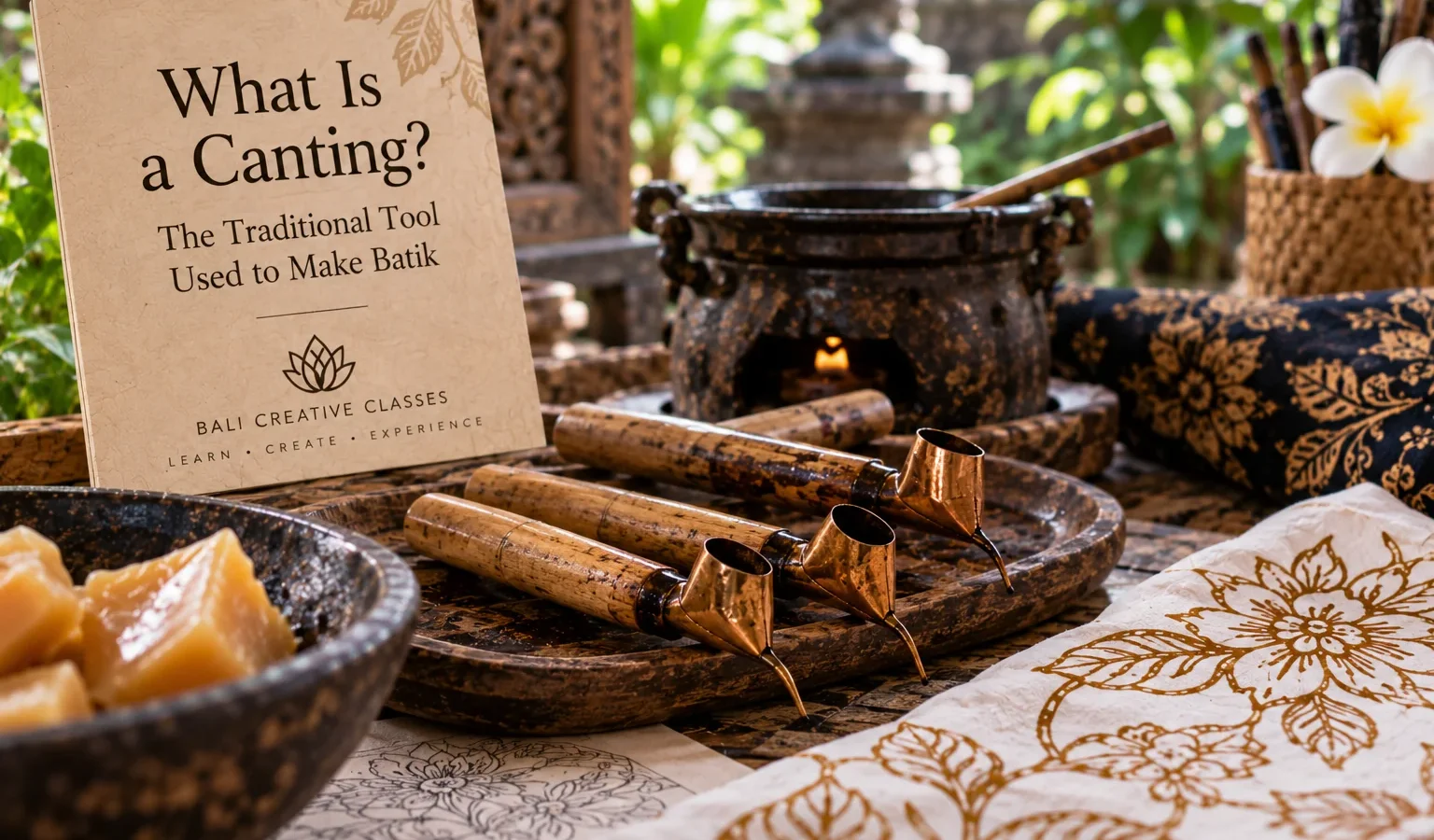
A canting is a small tool used to apply molten wax when making hand-drawn batik. It may look simple, but it gives the maker precise control over where wax touches the fabric. Those wax lines and dots later resist dye and help form the pattern.
If you join a hands-on Batik Class in Bali, using a canting is one of the clearest ways to understand that batik is a process, not merely a printed visual style.
What Does a Canting Look Like?
A traditional canting typically combines three functional parts: a handle, a small metal reservoir that holds hot wax, and a narrow spout through which the wax flows. The maker holds the tool at an angle and guides the spout over the cloth.
The reservoir carries only a small amount of wax, so the maker repeatedly refills it during hand-drawn work. The narrow opening allows lines and dots to be placed with more precision than broad wax application.
How Does a Canting Work?
The canting is filled with molten wax. As the maker moves the spout along the fabric, wax flows onto the fibres. When the cloth is later dyed, the waxed sections resist the colour. Removing the wax reveals the protected parts of the design.
The principle sounds straightforward, but controlling temperature, flow and hand movement takes practice. Wax that does not flow properly can interrupt a line; uncontrolled movement can place wax outside the intended area.
Why Is the Wax Important?
Wax is the resist in wax-resist batik. It temporarily blocks dye from reaching selected fibres. The canting is therefore not simply a drawing pen: it places a functional barrier that determines how colour behaves later.
Read how batik is made to see where canting work fits into the complete waxing, dyeing and finishing sequence.
Is a Canting the Only Way to Apply Wax?
No. Batik cap uses a patterned stamp, traditionally made from copper, to transfer wax to the cloth. A stamp can repeat motifs more efficiently across a larger area. Canting work, by contrast, is associated with hand-drawn batik tulis and allows freehand detail and variation.
Why Can Two Hand-Drawn Lines Look Different?
Hand pressure, movement, wax flow, fabric and temperature can all affect the result. That variation is part of the manual process. A beginner should not expect the same mechanical uniformity produced by a digital printer.
Understanding this makes a workshop more rewarding: the goal of a first session is not flawless imitation of an experienced artisan. It is to learn how the tool, wax and cloth interact.
Is a Canting Safe for Beginners?
It can be introduced to beginners under appropriate guidance, but it works with hot wax. Participants should follow workshop instructions carefully. Families with young children should confirm suitability in advance because age, supervision and workshop setup matter.
Our guide to Batik Class Bali for beginners and families covers these considerations in more detail.
What Can You Learn by Using a Canting?
Even a short attempt teaches several things that photographs cannot: wax has a particular flow, lines require controlled movement, the cloth absorbs the wax, and every protected line has consequences during dyeing. The tool turns the idea of “wax resist” into something physical and understandable.
Try a Canting During a Batik Workshop in Bali
In the Bali Creative Classes experience in Tohpati, participants are introduced to batik materials and use wax as part of a guided 30 × 30 cm cotton project. The session is designed as an introduction for visitors rather than a claim to master a craft in one afternoon.
Start with our guide to your first batik workshop if you want practical preparation. For the full experience with private transport and lunch, see Batik Class Bali. When your date is decided, use the booking page.