
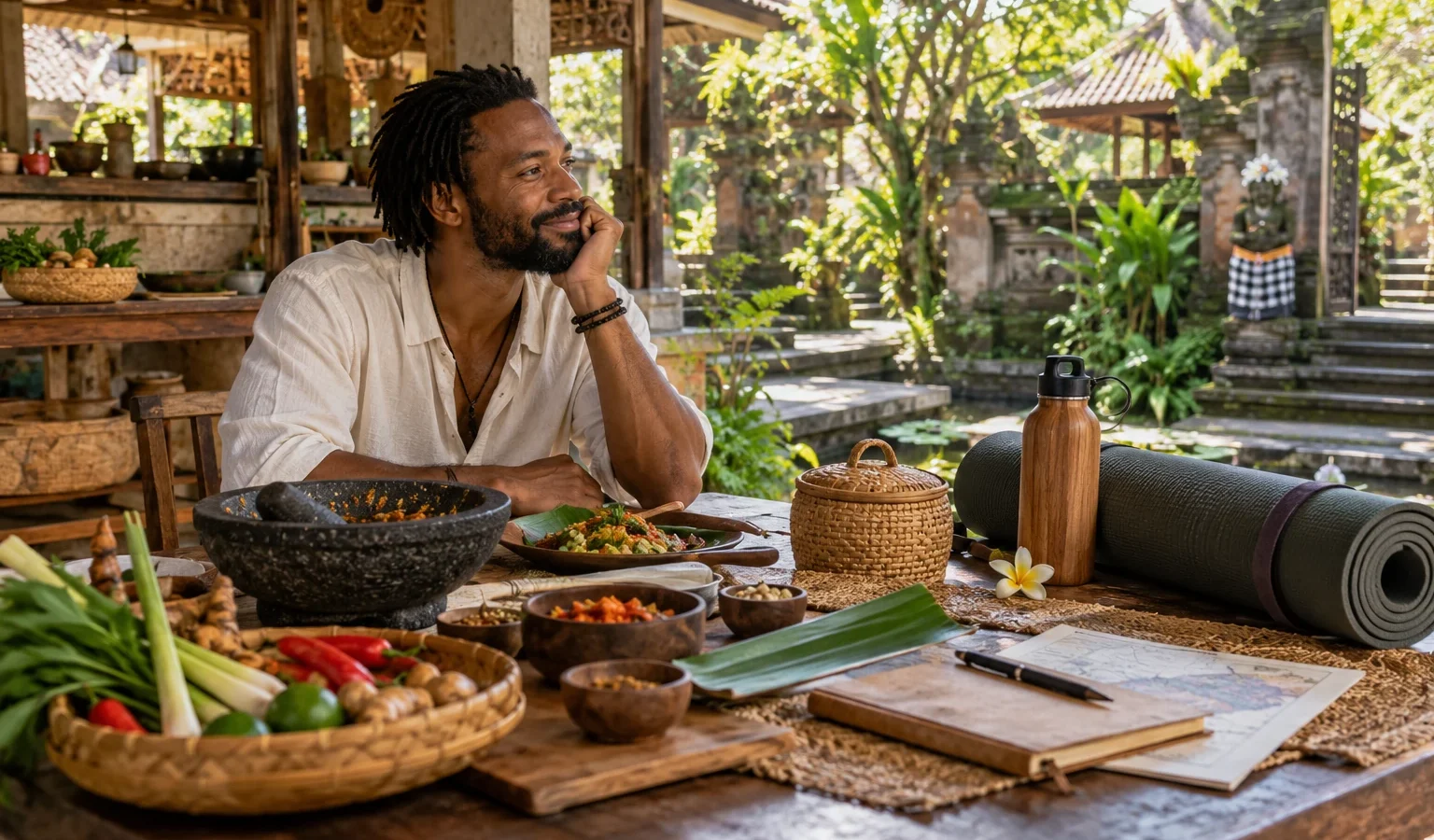
After a yoga and cooking day in Ubud, it is usually better to leave the rest of the day relatively flexible instead of immediately committing to another major timed activity.
There is no universal number of free hours that every traveler needs. The practical amount depends on when your experience finishes, where you are staying, how much transport remains, and what kind of evening you enjoy. The key is to avoid designing an itinerary that only works if the yoga, cooking, meal, transfers, and every later activity all finish exactly on time.
If you are still planning how the two main activities fit together, start with what to expect from a yoga and cooking class in Ubud.
Think in Terms of Buffer, Not an Exact Number of Hours
Travel planning often becomes too precise.
You may be tempted to calculate that an experience finishes at one time, another attraction starts shortly afterward, and therefore the schedule technically fits.
That approach ignores normal travel variables.
A more useful question is:
How much uncommitted time will protect the rest of my day if something takes longer than expected?
That buffer can absorb:
- a later-than-expected finish;
- traffic;
- a slower meal;
- changing or freshening up;
- returning to your accommodation;
- a short rest;
- or simply deciding that you do not want to rush into the next activity.
Free time is therefore not wasted itinerary space. It is what keeps the itinerary resilient.
Why a Flexible Afternoon or Evening Often Works Better
Yoga and cooking create a different kind of day from quick sightseeing stops.
Both involve participation. You are not simply arriving, taking a photo, and moving on.
A yoga session asks for your attention and movement. A cooking experience can involve preparation, learning, conversation, cooking, eating, and time with the people around you.
When the main activities are participatory, leaving a flexible period afterward gives you room to enjoy them without watching the clock.
That does not mean you must return to your hotel and do nothing. It means your next plan should ideally be easy to change.
What Counts as a Good Flexible Activity Afterward?
Activities without a strict start time are usually easiest.
Depending on your location and preferences, that might include:
- walking around a nearby area;
- stopping for coffee or a drink;
- browsing shops;
- visiting somewhere close that does not require advance entry;
- returning to your accommodation;
- having a relaxed dinner;
- or deciding what to do only after the main experience ends.
The exact choice matters less than the flexibility.
A spontaneous walk that can be shortened or skipped creates much less pressure than another prepaid activity with a fixed check-in time.
What Should You Be Careful About Booking Afterward?
Be cautious with anything that has a narrow arrival window.
Examples can include:
- another class or workshop;
- a timed performance;
- a long-distance transfer;
- a sunset plan far from your previous location;
- a reservation that is difficult to change;
- or an attraction that requires you to arrive before a specific closing time.
These activities may still be possible. The issue is not that you must avoid them.
The issue is whether your schedule leaves enough margin that one small delay earlier in the day does not threaten the next booking.
Does the Amount of Free Time Depend on Where You Stay?
Yes.
Where you finish the experience and where you need to go afterward can change the itinerary significantly.
Someone staying nearby may have more practical flexibility than someone returning to accommodation farther away.
If your day involves a longer transfer, treat that journey as part of the schedule rather than as invisible time between activities.
Travelers staying outside the immediate Ubud area should be especially careful about committing to another fixed event soon after the experience.
What If You Have Dinner Plans?
Dinner can fit well after a yoga and cooking day, but remember that a cooking experience may already include a substantial meal.
If meal timing earlier in the day is part of your planning, the guide to eating before a morning yoga and cooking experience covers that separate question.
You may not want another food commitment immediately afterward.
If dinner is important, a later and flexible reservation may be easier than planning an early meal without knowing how the cooking portion will affect your appetite or schedule.
This is a travel-planning consideration, not dietary advice. Your own routine and needs should guide your food choices.
Is It Okay to Plan a Cultural Activity in the Evening?
Potentially, yes.
An evening cultural activity can be a good contrast to a participatory daytime experience, particularly if it is nearby and the timing leaves a comfortable buffer.
Before committing, check:
- the confirmed finish time of your main experience;
- expected transfer time;
- the cultural activity's required arrival time;
- whether tickets or reservations are flexible;
- and whether you actually want another fixed commitment that day.
If the margin feels narrow, move the cultural activity to another day rather than turning the afternoon into a race.
Should You Return to Your Hotel First?
That depends on location and personal preference.
Returning to your accommodation can give you time to shower, change, rest, or reorganize before the evening.
But if your hotel is far from where you want to spend the evening, returning first may create unnecessary travel.
Look at the day geographically.
Sometimes the relaxed option is to remain in the same area. Other times, going back to your accommodation creates the break you need.
There is no single correct pattern.
How Does the Morning Schedule Affect the Rest of the Day?
An earlier start can make it easier to preserve afternoon flexibility, but the exact result depends on the experience.
If you are deciding how to structure the first half of the day, the guide to the best order for yoga and cooking in Ubud explains why the sequence matters.
A clean morning schedule can reduce unnecessary transitions and make the later part of the day easier to manage.
However, do not assume an early start guarantees an early finish. Always use the confirmed itinerary.
What If You Want to Maximize a Short Ubud Stay?
Short trips create the strongest temptation to overbook.
When you only have a limited number of days, every open hour can look like an opportunity to add another attraction.
But maximizing the number of bookings is not always the same as maximizing the quality of the trip.
If yoga and cooking are important experiences for you, protect them first.
Then add one flexible activity afterward rather than several fixed commitments.
This gives you a useful fallback: if the main experience finishes early and you still have energy, you can do more. If it finishes later or you want to slow down, nothing important is lost.
Free Time Is Also Useful for Unexpected Opportunities
Not every good travel moment appears in the itinerary.
You may discover:
- a shop you want to explore;
- a café you want to try;
- a conversation you do not want to cut short;
- a nearby place recommended by a local;
- or simply an area you want to walk through slowly.
An overbooked schedule makes those opportunities difficult to accept.
Leaving part of the day open allows the itinerary to respond to what actually happens.
How Much Buffer Should You Leave Before a Fixed Evening Plan?
There is no universal buffer because Ubud-area travel time and activity schedules vary.
Instead of relying on a fixed formula, work backward from the evening commitment.
Ask:
- When must I actually arrive?
- How long could the transfer reasonably take?
- Do I need to change first?
- What happens if the daytime experience ends later than expected?
- Is the evening booking refundable or movable?
If the schedule has no room for a normal delay, it is too tight.
That is a more reliable test than choosing an arbitrary number of free hours.
Does Leaving Free Time Mean the Day Is Not Full Enough?
No.
A day built around two meaningful participatory experiences can already be a substantial travel day.
If you are deciding whether this kind of experience-led schedule can take the place of a conventional sightseeing day, see Can a Yoga and Cooking Day Replace a Full-Day Ubud Tour?.
The Yoga and Balinese Cooking Experience in Ubud is better understood as an experience-led day rather than a checklist of attractions.
You do not need to add another major booking simply to justify the day.
For many travelers, having enough time to move between activities without rushing is part of what makes the experience enjoyable.
What If You Prefer a Very Active Itinerary?
You can still add more.
The important distinction is between optional activity and another commitment.
An active traveler can use the free period for walking, exploring nearby areas, shopping, or adding a spontaneous stop.
That keeps the day busy without making the schedule fragile.
If you already know you enjoy tightly packed itineraries and are comfortable with the logistics, you may choose differently. Just make the decision using real travel times and confirmed schedules rather than optimistic assumptions.
A Simple Way to Plan the Rest of the Day
Use three layers.
Layer 1: Fixed
Your yoga and cooking experience.
Layer 2: Protected buffer
Transport, transition, changing, and uncommitted time.
Layer 3: Optional
Nearby sightseeing, shopping, café time, dinner, or an evening activity that can be adjusted.
Build the itinerary in that order.
Do not start with a full list of attractions and then try to squeeze yoga and cooking into the remaining gaps.
Final Answer
You do not need a fixed number of free hours after a yoga and cooking day in Ubud. What you need is enough uncommitted time that a normal delay, transfer, meal, or desire to slow down does not disrupt the rest of your itinerary.
For most travelers, that means keeping the later afternoon or evening relatively flexible and avoiding another major timed activity immediately afterward.
Plan the fixed experience first, protect a buffer second, and treat additional activities as optional whenever possible. That creates a fuller day without making it a rushed one.