
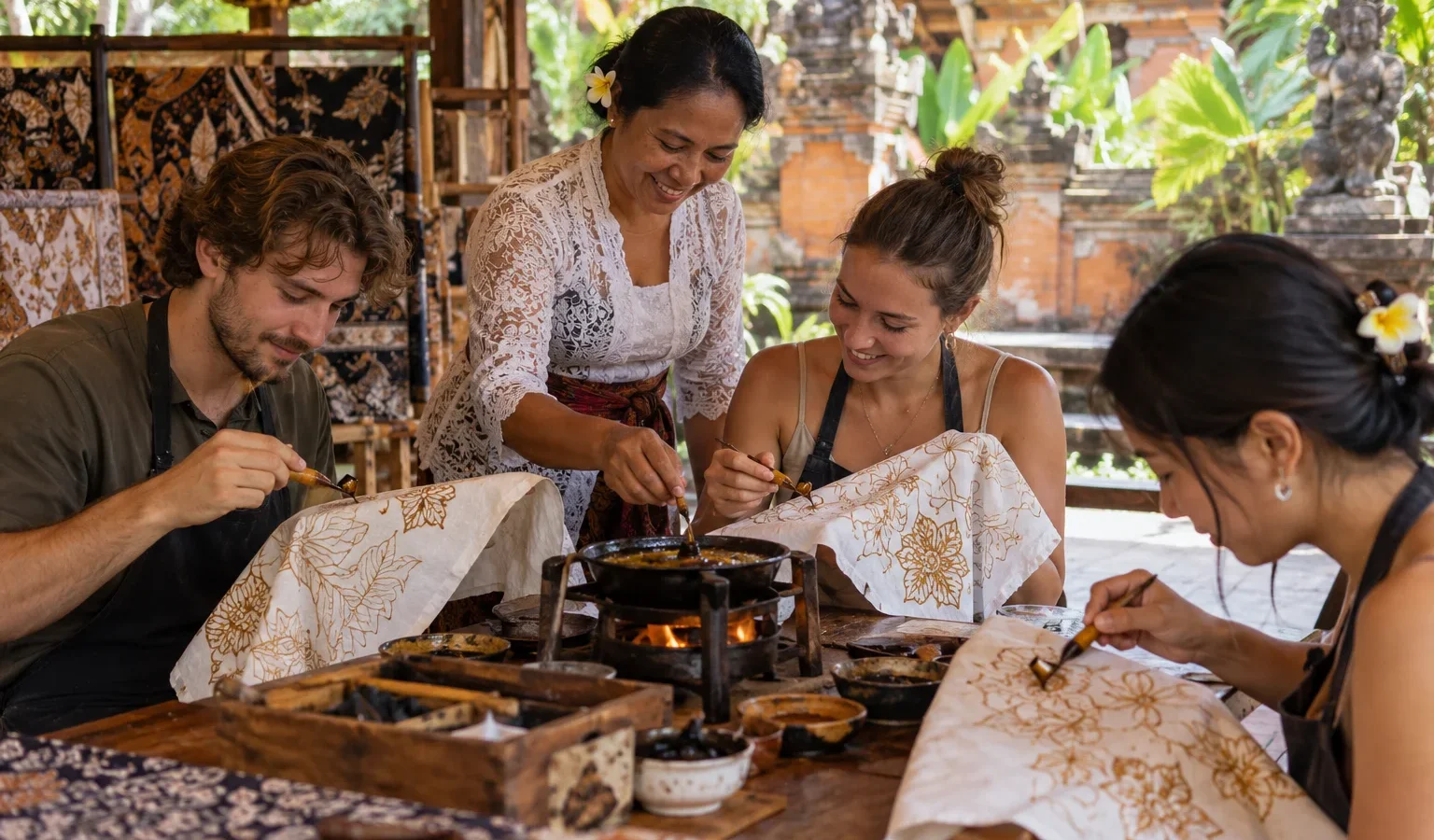
If you have never used a canting or worked with hot batik wax, it can be difficult to picture what a batik class in Bali actually feels like. The experience is more practical than a museum-style demonstration: you learn the basic tools, work on fabric and see how wax and colour interact.
The exact sequence varies by workshop, but the verified Bali Creative Classes reference package gives us a clear picture of what guests should prepare for.
You Begin With the Tools and Materials
Before applying wax, you need to understand what you are holding. A canting is a small tool used to guide liquid wax onto fabric. The wax acts as a resist, protecting selected areas from dye.
A beginner class should explain the materials before asking you to work. You are not expected to arrive knowing the technique.
The Hands-On Part Requires Patience
Applying wax is one of the most memorable parts because it feels different from drawing with a normal pen. The wax is hot and flows differently, so controlled movement matters more than speed.
Small irregularities are normal in handmade work. The purpose of a beginner workshop is not to reproduce a machine-perfect textile. It is to understand the process by doing it.
Colour Changes the Piece
After wax application, the fabric moves into colouring. The verified BCC reference class includes dip dyeing in one colour, a dyeing sequence and wax removal. Once the wax is removed, the protected and coloured areas reveal the design more clearly.
This progression—from blank fabric to waxed design to coloured finished piece—is what makes the workshop satisfying for many first-time guests.
For the exact package components, see what is included in the batik class.
The Workshop Is Part of a Larger Half-Day
The BCC reference itinerary is approximately six hours overall. It includes hotel pickup, the batik session, lunch and the return journey. The workshop itself is around 90 minutes.
That distinction matters. If you are asking how long a batik class takes, decide whether you mean the hands-on session or the full experience from pickup to return.
You Leave With Something Connected to the Experience
For the verified package, the working piece is a 30 × 30 cm cotton fabric. Finishing and wax removal are part of the process, and the package includes a completion certificate.
The object matters because it gives the activity a physical memory. Instead of only photographing someone else’s craft, you have taken part in making a piece yourself.
Lunch and Transport Change the Rhythm
A bundled experience feels different from walking into a studio for an hour and leaving. Transport removes part of the navigation problem, while lunch gives the itinerary a natural pause after the class.
If you are comparing workshops, use the booking guide to check the full format rather than only the workshop description.
What Beginners Should Expect Emotionally
The first few lines of wax may feel awkward. That is normal. Most beginners need a little time to understand the flow of the canting and how quickly to move.
Try not to judge the experience by whether every line is perfectly smooth. A better measure is whether you understand more about the craft after making something yourself.
Ready to Try the Process?
A batik class is best approached as guided making rather than a performance test. Expect instruction, concentration, a few imperfect lines and a much clearer understanding of how wax-resist batik is created.
Related Reading
- What to Know Before Booking a Batik Class in Bali
- How Long Does a Batik Class in Bali Take?
- What Is Included in a Batik Class in Bali?
- Explore the Batik Class in Bali
- Check current Batik Class booking options