
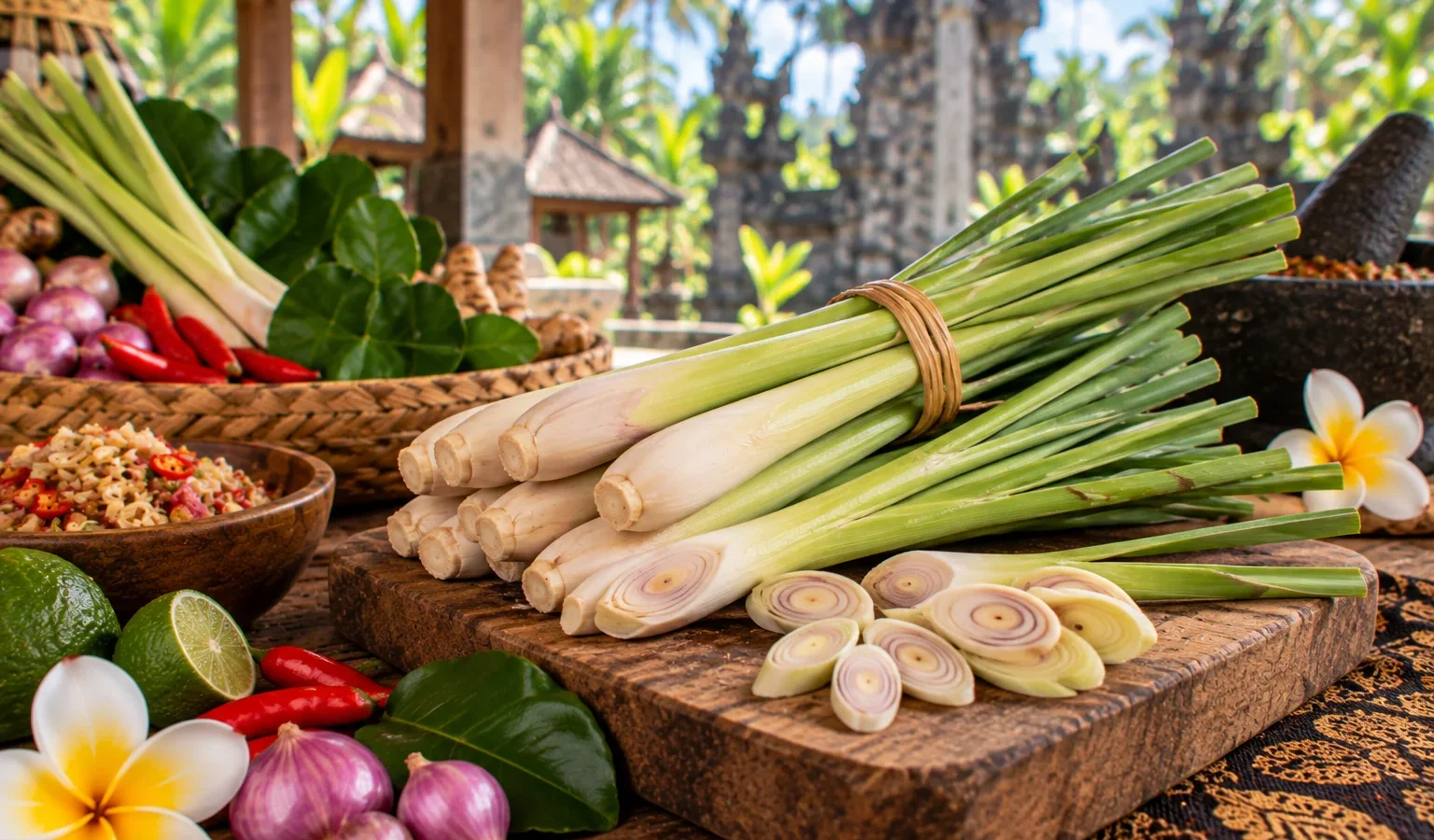
Lemongrass is an aromatic ingredient used across Southeast Asian cuisines, including Balinese cooking. Its citrus-like fragrance can add freshness and complexity without behaving like lemon juice or lime juice.
For travelers learning about Balinese food, lemongrass is a useful ingredient to recognize because it often appears alongside other fresh aromatics and spices.
What Is Lemongrass?
Lemongrass is a tall aromatic grass whose stalk is used in cooking. The lower portion of the stalk is especially useful because it carries much of the fragrance associated with the ingredient.
What Does Lemongrass Taste and Smell Like?
Lemongrass has a fresh citrus-like aroma with herbal notes. Its character is distinctive: it suggests lemon, but it is not simply a substitute for citrus juice.
Which Part of Lemongrass Is Used for Cooking?
Cooking commonly focuses on the stalk, particularly the tender lower portion. Preparation depends on the dish: lemongrass may be bruised, sliced, chopped, or incorporated into a seasoning mixture.
How Is Lemongrass Used in Balinese Food?
In Balinese cooking, lemongrass can contribute aroma to spice mixtures and cooked dishes. Its role makes more sense when considered together with ingredients such as galangal, turmeric, chilies, and other aromatics rather than as an isolated flavor.
Lemongrass and Balinese Spice Pastes
Balinese cooking often builds flavor by combining multiple fresh ingredients. Learning about Balinese spices and aromatics provides a broader foundation for understanding why ingredients such as lemongrass work well in layered seasoning mixtures.
Fresh Lemongrass at Local Markets
A local market can be one of the easiest places for travelers to recognize lemongrass in its fresh form. Seeing ingredients before cooking them creates a useful link between the market and the kitchen.
This is also why a Bali cooking class with a market tour can provide more context than encountering the finished ingredient only on a plate.
How Lemongrass Works With Other Balinese Aromatics
Lemongrass does not create Balinese flavor by itself. Its aroma works as one part of a broader combination of spices, roots, leaves, chilies, coconut, and other ingredients.
For a deeper look at one of those companion ingredients, see our guide to galangal in Balinese cooking. You can also explore how these ingredients come together through a Balinese cooking class near Ubud.
For another ingredient used in Balinese spice mixtures, see our guide to candlenut in Balinese cooking.